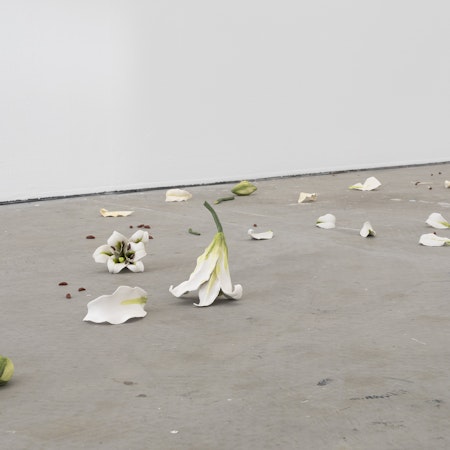
It is widely believed that during the gold rush years, Chinese miners brought lilies to Aotearoa New Zealand. As a result, these white lilies have become endemic to Aparima Riverton, a town on the country’s southern tip. At once an exotic curiosity and a weed, the plants symbolise the always complex position that the migrant occupies within the European settler-colonial framework. This is why the lily forms the basis of Cindy Huang’s work Tracing a Gilded Trail (2023–)[1] which, together with a new commission, Kitchen Floor Glimmer (2026), was recently on display at Melbourne’s Gertrude in Huang’s solo exhibition Landings.
At Gertrude, Tracing a Gilded Trail was very deliberately dispersed precariously across the gallery’s concrete floor. The installation was made up of whole lily flowers sculpted from porcelain, as well as individual leaves and, most dauntingly, singular stamens and anthers. Of the stress-inducing task of navigating these tiny ceramics, Huang says ‘I like to encourage a little bit of discomfort in the audience members.’ Huang does not infantilise her viewers but gives them the responsibility to navigate the 1000-odd pieces on their own. Traversing the installation, one also gets the sense that Huang’s ceramic lilies form a complex network. It is this idea of a network—that is, a messy system where certain parts coalesce and other sections diverge—that is a good summation of Huang’s practice. Because, as we will see with Landings, Huang seeks to demonstrate how relationships in a colonial nation-state aren’t restricted to that of coloniser/colonised, nor can the players within a colonial nation-state be viewed through the reductive lens of good or bad.
The starting point for Landings was the Chinese settlers in Aotearoa and the role that they have played in the country’s economy. Here, Huang thought about unofficial economies, the way in which, over the centuries, Chinese and Māori have at times engaged in mutually beneficial barter systems that sidestep the colonial market economy. In the early-20th century, the Tohunga Suppression Act 1907 criminalised traditional healing practices of Māori (though it is believed to have simply pushed the practice underground rather than stamping it out), some turned to the Chinese to provide them with natural medicines. During a period of intense research in Otago, Huang spoke with a kaumātua (Māori elder) and learned that Chinese goldminers provided Māori with natural remedies for which they received foraged goods in return. Huang notes that lily bulbs are often used in traditional Chinese medicinal recipes. They have cooling properties which, as Chinamaxxers should know, are believed to clear heat and calm inflammation. We can therefore speculate that the bulbs were brought to Aotearoa to be consumed rather than germinated.


Accounts of Chinese miners bringing lilies to Aotearoa only exist through oral histories passed down between generations. To the best of Huang’s knowledge, there are no official recordings of the lily’s introduction into Aotearoa. There are, however, official records of the same transportation and dissemination of lily bulbs occurring in California, which gives credibility to the theory—though not enough to make it official in the historical-record way that dominates knowledge production. But, as we know all too well, it is often unofficial forms of record-keeping and (largely oral) lines of communication through which non-dominant forms of historical narratives are preserved. In representing an unsubstantiated history and—further to that—one not centred on settler colonial relationships with ethnic minorities, Huang complicates the dominant narratives that we have come to expect from gold mining histories. And, as her complex web of lilies symbolises, she also refuses to fall into the common trap of good vs evil/victim vs perpetrator that usually surrounds colonial history. As she notes, Chinese miners also played their role in desecrating the natural landscape to build personal and community growth. Huang’s ancestor, for example, used the funds to build roads and a temple in his home village upon returning to China. Not to mention that the introduction of the lilies almost certainly disrupted the native ecosystem in which they continue to grow wild.


Where Tracing a Gilded Trail speaks to the historical position that Chinese migrants occupied in gold rush-era Aotearoa, Huang’s new commission for Gertrude, Kitchen Floor Glimmer (2026), is rooted in the present day. Composed of a series of tiles containing crustacean and mollusc shells, the installation implicates Huang’s own father as simultaneous barterer and orthodox business owner. Huang’s parents live in a small town famous for its geothermal attractions. A significant portion of the town’s wealth comes from tourism, and many of those tourists are Chinese. In their town, Huang’s father owns a beloved restaurant and takeaway shop that has become a destination for those tourists—a fact that has, in recent years, been exacerbated by social media (just lately, a Chinese television show shot a segment from the restaurant).
Huang tells me that, in a curious act of hoarding, her father keeps all the shells from the seafood that he serves at his restaurant. For Kitchen Floor Glimmer, Huang has taken these shells and embedded them into tiles, which were then arranged on Gertrude’s floor. There are, of course, parallels between the example of the Chinese gold rush miners and Huang’s father, insofar as, in both instances, there is an exploitation of the natural environment to capitalist ends. In addition to common shells such as mussel and oyster, the tiles also contain pāua, a native mollusc that is served to tourists at the artist’s father’s restaurant, is also a popular memento sold at souvenir stores—Huang describes it as ‘very Kiwiana’. It would seem that Huang’s father also collects the shells as a fall-back plan. He tells his daughter that if she fails at being an artist, the shells are always there for her to sell. This is the type of Chinese entrepreneurship that children of immigrants become very familiar with.

An ancient Roman mosaic dating from the 2nd century BC titled Unswept Floor (Asàcrotos òikos) served as an influence for Kitchen Floor Glimmer. In the mosaic, we see nut husks, crustacean shells and bones strewn across the floor in the aftermath of a feast. The link between this ancient excess and that of Chinese tourists is apparent. The popularity of Huang’s father’s restaurant is, in part, a symptom of a trend amongst Chinese to signal their wealth through food tourism. Seafood indicates a level of prosperity—and often a performed prosperity at that. These leftover shells, faithfully collected by Huang’s father, are remnants of a much more complex economic system of trade and tourism that hinges on the myth of possibility that the ‘imagined paradise’ offers, says the artist.
Recently, Huang’s father has also begun collecting pounamu, or greenstone, a form of jade used by Māori to carve taonga (treasured item), such as the hei tiki. The artist’s father’s obsession is so great that he has formed a relationship with a pounamu carver, with whom he exchanges the treasured stones for restaurant vouchers. In presenting this work alongside Tracing a Gilded Trail, Huang traces a link between the unofficial economic systems established between Chinese miners and Māori during the goldrush and that of her father and his pounamu carver now. But while an emphasis has been placed upon these barter systems, what also bears reminding is that the bartering happened/happens within the broader capitalist economic framework. Chinese migrants flocked to the goldfields to make money in exchange for the mineral they extracted, Huang’s father exchanges meals for legal tender. Huang might be trying to tell us that the official and unofficial are never totally separate. Just as the unofficial narrative of the lily is never far from the official gold mining narratives entered into the historical record.


[1] Tracing a Gilded Trail is an abbreviated title taken from a poem by Huang
Follow the smell of his faint breath
The sound of whispered past
Sifting flour gold
Sea edge resettled