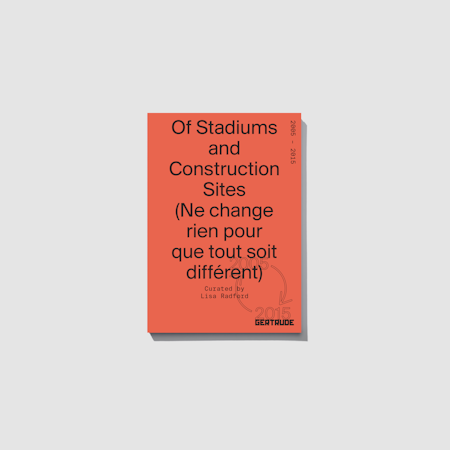
The title of this public program performs the salutation. I will not repeat it. Yet another decoy, another beginning, temporary origin or middle masquerading as inception. A montage methodology, Fiona Macdonald and Sean Peoples bookending essays by Patrice Sharkey and Rosemary Forde—in the gallery A Yummy Fantasy faces off A Constructed World.[1]
This dispatch is not correspondence. It is a rhizomatic mess of schizo methodologies and productive contradictions, a handover without instructions, a salute without an army. Diego Ramírez, in a Bureaucracy of Feelings, can a spreadsheet cope with cringe?
Etymologically, to dispatch is 'to get rid of promptly by killing'. As Ragnar has noted, It is a deeply personal art history.[2]

Here in the antipodes, we like to have 'Global North precedents'. A.A Phillips (1950’s) Cultural Cringe weathered only slightly by Whitlam’s sweeping cultural revolution of the 1970’s resulting in a plethora of 40 and 50th birthday celebrations for arts orgs such as this. Culture, is the same age as Amanda Marburg and I, apparently.[3]
Artists asked to reshow, remake, redo that which they left being 20 years ago comes with baggage. Work is missing. Work is destroyed. Work is in collections of people artists might not know. Work is subject to life. A kind of terrifying irony bestowed on us—to be making exhibitions alongside very visible and public failures in policy—lateral violence, the censorship of artists and the rescinding of offers.[4] Policy is to police. Can looking at a very specific specificity of context mean the parochial can be examined in a manner that might alleviate it of its own burden shedding light on its paradoxes and pertinences?[5]
This was an 18-month long séance with an archive of ghosts—thousands of images and texts evidential of the depth and complexity of practice, board papers that reveal nothing and everything, artists who don’t pay rent, artists who pay rent, underpaid employees, barely paid artists, a revolving door of volunteers, photographers, installers and lists. Lists of ideas, lists of peoples, lists of to do, lists of money, lists of lack of money interspersed with the incident reports sans political inference or noted personal grievances. Of note, perhaps just for me, but I like thinking also for us, a proposal for a show about grief, rejected at this time, the sentence read 20 years later, very-much-a-lifeline.[6]

Parallels and precedents.
In 2015, Hal Foster published a short text titled Bad New Days: Art, Criticism, Emergency.[7] Openly acknowledging that his focus is New York centric (what we love about West Coast Ed Rusha and Mike Kelley, or Dresdens Sigmar Polke and Gerhard Richter), Foster looks at what happened post 9/11, his suspicion of the death of irony and what he refers to as the 'probing of the real'. In his examination of material, matter and concept, Foster loosely categorises art via adjectives 'Abject', 'Archival', 'Mimetic', 'Precarious' and 'post-critical'. These terms are not irrelevant in our military settler-colony, they too are linguistic symptoms paralleling our incomprehensible Mnemosyne.[8]
Second, Mark Fisher talks about our dimension of the future having disappeared—the futures slow cancellation while the 20th century appears in high def on our screens—trapped and marooned amongst Capital Realism where almost nothing can be abstracted or extracted from the realities of business, Fisher proposes nostalgia and depression become productive escapes.[9] Chris Nolan’s Memento and Oliver Sacks, The Man who Mistook his wife for a hat—our amnesia and lack of long term coding.[10] During prep for the exhibition, I emailed Art Historians:
Dear *******,
I am not sure where to direct this email, as numbers are such a funny stat to want in art. But I am working on this exhibition for / at Gertrude Contemporary for which both Rose Forde and Patrice Sharkey have written, based on their MFA and Honours papers which both look at local conditions in Contemporary Art History – writing and Melbourne Arte Povera respectively.
I know that Dave Homewood did his PhD on Dale Hickey et al. and I was wondering how many PhD’s, MFA’s and Honours papers in Art History look at contemporary or recent art history in Australia / Melbourne.
Far from a patriot or nationalist, I guess I am interested in the how the local is negotiated in this space in Art History, or if this history is more often than not documented by artists and curators themselves (in PhD and MFA).
Let me know what you think, or even better, if you would like to discuss.
Best, Lisa [11]
Replies were akin to: not sure I will get back to you. And yes, Diego, I am still waiting.
But on that note, in 2011 one of the books missing from the surplus archive, Minimal Domination by Justin Clemens was published. A selection of writing on art from the decade prior. In the liner notes, we are made aware that the title is drawn from contemporary mathematics: a minimally dominating set is the smallest set of points that neighbour all other points of a graph. A minimally dominating set is therefore a multiple and a structure which has privileged access to that which it is not. This is the secret of contemporary art: it creates discrete selections from which we can survey the whole. [12]

Somewhere between Foster, Fisher and Clemens (which sounds like an architecture firm), emerged a framework informed by the socio-political events of the time alongside their parallels and precipitations in art and culture. Some I have already mentioned: 9/11 and the deaths of artists Blair Trethowan, and Mutlu Çerkez, but there is also many more: the Tampa Affair, the GFC, the Aceh Tsunami, the Arab Spring, Cronulla Riots, Germaine Greer’s Whitefella Jump Up, a War on Terror, the Biennale Protests, the London Riots, drones, Facebook, Twitter, Julian Assange and Collateral Murder; Wikileaks, Woomera and the Kyoto Protocol; the Mumbai Bombings, a Large Hadron Collider, and the Australian political bureaucratic coups: Howard, Rudd, Gillard, Rudd, Abbott.
The acceleration of online communications, from mobile roaming to data downloads, blogging and more vlogging, re-brand—social media: Jonathan Nichols STAMM, Kate Smith’s Bethungra blog, ACW’s Speech and What Archive, Ja Ja Sphinx[13]. Considering the demise of Art + Text, we found Discipline, UN Magazine and Surpllus fighting a funding world of rapid 'professionalisation,' arts workers, check boxes and validations for art.[14] The explosion of artist run spaces and new dealers (Uplands, Neon Parc and Sarah Scout) mirrored the emergence of arts managerial class, gentrification, grant writing, and 'placemaking'.[15]
As the city gentrified and rents increased, artist lead spaces vacated for the burbs, or factories for culture.[16] By the end of this decade Gertrude was moving to Preston, ACCA's NEW exhibitions promoted 'new' art siphoned into a collection of solo shows housed in a kunsthalle each coming with their own catalogue essays, sans curatorial question, or even an attempt at examining art as its own symptom of something be it decay, dismay or dilemma.
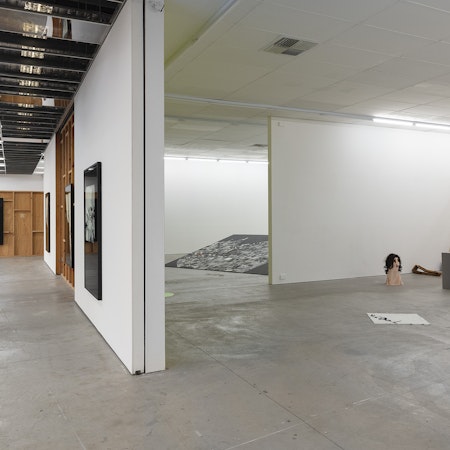
You’ve walked in here under what I call the drunken ceiling, and perhaps many times over the last few months—the office ceiling grid, re-dressed with Perspex filled with bourbon and coke—the banality of commerce avoided by Mad Men and Wolves of Wall Street.[17] Shown at Murray White Room in 2008, and originally titled Low Expectations, this sculptural installation and iteration floods the foyer and presents to the streets a blacked out array of images—protests in Belfast or the Neo-Nazi from the Netherlands demarcated behind that ‘X'. Elon Musk—any thoughts? A young Pat Foster has said of the work, 'when you break a window there’s this really conscious decision and a conscious act. There’s something really nice about this unconscious body and the loss of control forming some kind of response to public space. Forms can come into existence through different means and different influences. The world is shaped through interaction in broad terms.' [18]

Making present simultaneously architectural and social structures office aesthetics cum inebriated coping mechanisms, Foster and Berean’s work re-created and re-staged here as ready-made-in-the-roof materially manifesting a composition of words not yet written by Brett Easton Ellis and all the images of excess relayed through media when wall street crashed in the same year. Sub-prime loans—Foster and Bereans re-collection calls to question our own hand in the making even if in apathy or Lower Expectations.[19]
The peripheral and feeder scene that grew around and helped establish Gertrude included—squats and speakeasies, temporary holds and pop-ups: Hell Gallery, Open Archive, TCB, Conical, Y3K, Utopian Slumps, Rearview, Bus, Seventh, The Narrows and Techno Park, Joint Hassles, Dudespace.[20] The materiality of history is a density not a destiny. Prefunding, post funding, market lead, institutional frameworks — mentors, mentors, mentors — from abstraction to moral aversion, moral inflection and back again. Seemingly always begging, Please sir, may I have some more?[21]
Danielle Freakley’s iconic Quote Generator a 3-year project, a life-long commitment.[22] Learning hundreds of fragments of responses to respond to, what eventually is revealed, to be the small talk of our daily lives, be it at the exhibition openings on Gertrude Street at G street or on TV in shared viewing, our ABC and Denton’s enough rope—Yes, Optus 1998.[23] An impenetrability, a rupture in the illusion of intimacy and connection. A durational performance that made present the pleasure of our own cultural consumption, the cannibalism of capital as oral fixation—that’s right, Danny Boy, enjoy your Symptom (Slavoj Zizek, 1992).[24]

I look at Sharon, Ian, Tracy, Mark and Brigid and think about Alexi, Amita and Emily.[25] I think about the more than 200 images on my collapsed wall thinking of Stephen Brahm.[26] I think about small groups and good intentions, deadlines, disasters and drama. The significance of Vernon Ah Kee’s Tall Man (2010) shown at Gerty but now at the TATE.[27] History Painters become sculptural installations, Nicholas Mangan’s Colony, Alex Martinis Roe’s Feminist round table, Alexi Glass, Justin Clemens, Helen Johnson and Antony Lowenstein, negating the representation of race, colonies and a history always already unspoken.[28] You at the pool in the party at that collectors house. Artists that exodus and expat, artists that go to and come back, home. The students who are now my peers and friends who could find some of themselves in Holly Childs Danklands, Azza Zein’s audible archive and composition carpet of an Arab Spring, Ezz Monem’s Coca Cola used in Tahir Square, less mute and maudlin than in the that ceiling! Fayen d’Evie’s star signs for dictators, Colleen Ahern’s disco ball at TCB refracting in paint all of us and all of her heroes, our heroes. Kate Just's knitted ovaries, Anna Higgins' Higgs Boson and yesterday’s meme expressing an apology from Switzerland for destroying the world revealing we lived in a parallel time and place was relatively reassuring.
Archives intersect with memory, artworks lost, remade and revoked. Mathew Griffins' Bounty on Time Magazines Murdoch pre-dating a still yet to happen Royal Commission—to dispatch, is to kill off.
Thomas Ragnar’s review is a far better conjure.

A few months ago, when Ardi Gunawan was here, he handed me the Vincent Namatjira Royal Tour catalogue. A series of works by the Vincent where he inserts himself, a few dingoes and central Australian landscapes into the documented history of Royal visits to Australia. More correctly, he displaces the Royals, re-images them as visitors into his life, dismantling their appearance of power, humbling them. Vincent’s humanist, sloppy, satirical paintings, prints and collages make zombies of the royals, rendering their representation, through the apparatus of photography and its proof-of-purchase, mute in the language of his determined forms.
There is a through line between Namatjira and Gunawan, a critique and question to the images that dominate in a capitalism where excess melts into images enmasse via algorithms in our hands. Mark Fisher said Capital is an abstract parasite, an insatiable vampire and zombie maker. A visceral image extrapolated by Fisher where flesh is converted into 'dead labour' and the 'zombies made are us'. (Fisher, 2009). Written in the aftermath of failed wars on terror, global economic collapse, Fishers remarks seem to precipitate also an always-already-never-ending-endism. Ardi’s puppets, are also just that.
Techno-newism masquerades as anecdote at best, revolution at worst, set to fail amidst a jungle of in distinguished and unspoken class realities. Gunawans puppets from this time melt into the realities of this present time—sickly sweet neo-nostalgia’s, looping a future predicted from the past into a past that is seemingly always present. Unattainable images and proposed resurrections, Gunawan’s dance between abstraction, absurdism and representation caught in pigmented plasma or fluffy fabric is a less a moral musing, more gifted observation. Your neo-liberal office as abject jelly roll sourced from stock-pot images, our art friends in a macabre make-over, we can’t seem to find their faces, over and over again, while the mundanity of the water cooler conversations breaks the datafication of our labour. Mike Kelley’s lumpenproletariat meets Beckett.
Gunawan’s body shares that encounter—our bodies share that encounter, with mass en masse; tired infrastructures alongside a glistening new. A body politic in painting, in performance, in play were the liquid reality of false promises, the despair of pleasure in an excess of consumption. How and what does one speak when faced with the onslaught of livestreamed barbarism? While the immediacy of A.I. satire drifts into algorithmic history. Is it Gunawan’s puppets that will sit with us for more than the moment, their empty eyes laughing at us while we cry?

All that is solid, melts in Jakarta. This text I stole from myself.
I probably should have just sat here smoking topless.
Yours, with relentless optimism.
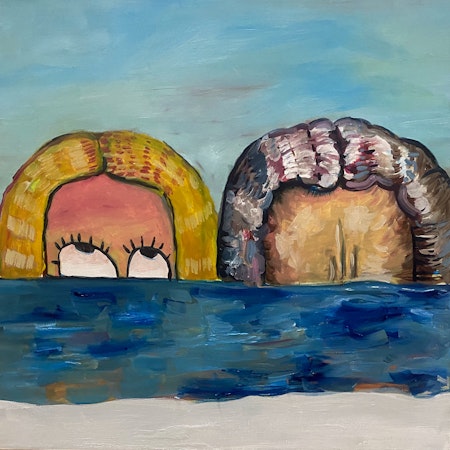
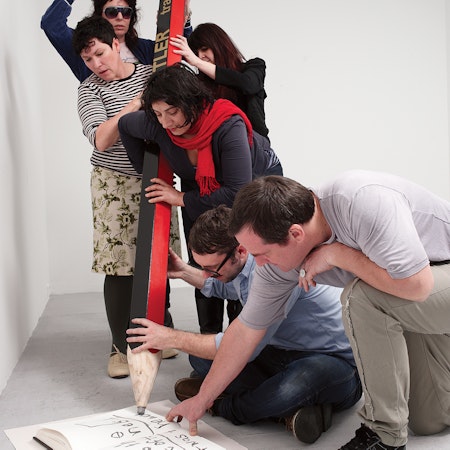
[1] A still from Fiona Macdonald’s Museum Emotions, 2003. HD video 100 mins referred to as the Bunny Room is used as the opening image for the catalogue as index for a collection of works in the exhibition that either refer to or are made by communities of artists practicing at the time. As bookend, a still from Sean Peoples’ Channel G project, first presented at West Space in 2013, is virtually rebroadcast in 2025 on the occasion of Of Stadiums and Construction Sites (Ne change rien pour que tout soit différent). Peoples staged Channel G at West Space, transforming the gallery’s back space into a temporary, makeshift film studio that broadcast live and unscripted video content produced by an ensemble of local contemporary artists and friends of Peoples. A Yummy Fantasy comprises series of exhibitions instigated and organised by Alex Vivian and Kate Smith who worked with friends to exhibit works I often refer to in the lineage of Art Povera and dirty pop subjectivity. Their poetic punk material poked fun at the 'history of art with a capital H' while simultaneously contextualising themselves within the canon. Patrice Sharkey’s accompanying essay (insert link) unpacks this history. A Constructed World began in 1993 and comprises Geoff Lowe and Jacqueline Riva, their expansive work folds painting into performance and ready-made into relic, they challenge authorship and encroach the multiple and multilingual through exhibitions, writing, events and affability. Disagreement and discord are as practice, across practitioners.
[2] Thomas Ragnar reviews the exhibition prior to its closing for Un Magazine, Nullus fumus sine igne, June 2025, https://unprojects.org.au/article/nullus-fumus-sine-igne/
[3] Amanda Marburg is an artist, together we were part of DAMP, we helped to run TCB artinc. and appear together in A Constructed World’s work Where there is smoke there is a smoker, 2005 filmed in early December Turin, 2004, included in the exhibition.
[4] Khaled Sabsabi and Micheal D’Agostino’s selected representation of Australia at the Venice Biennale 2026 was rescinded in February 2025 and then re-instated in July the same year.
[5] Think Woody Allen’s relationship to New York as John Waters is to Baltimore and Jef Geys might be to Ghent.
[6] Respected and influential artist Mutlu Çerkez died in December 2005 and our colleague and friend Blair Trethowan, passed away in March 2006.
[7] Hal Foster, Bad New Days, Verso Books, 2015.
[8] For the exhibition, I staged a collapsed pin-board-cum-skate-ramp-yearbook hosting the tip-of-an-iceberg of images stolen from the Gertrude archive and interrupted with selected images from invited friends, ex-students and colleagues at the VCA.
[9] Mark Fisher’s Capitalist Realism came up in conversation regularly with artist Ardi Gunawan and his restaging / remaking and completion of the zombie puppet work luckily there is no inside.
[10] Chris Nolan’s Momento was released in 2000 and Oliver Sacks influential book The Man that mistook is wife for a hat, was published in 1985. Both are consumed by art students in the 90’s and are still popular today as means for thinking through the role and relationship between images, materiality and how we remember.
[11] Emails from the author to various Art Historians occupying roles at various Universities April-June 2025.
[12] Justin Clemens, Minimal Domination, Surpllus Books, 2011.
[13] Stamm was an online publishing project initiated by artist Jonathan Nichols in 2012 https://stamm.com.au/; Kate Smith’s blog was visited and discussed at bars and openings by friends and foe https://katedsmith.blogspot.com/; Speech and What Archive hosted by A Constructed World and friends between 2009-2013; Christopher LG Hill with Josh Petherick, James Deutscher, Nicholas Mangan, Helen Johnson, Matthew Brown, Nathan Gray and friends, listed as 'everybody', have posted once a month since 2006 – ongoing. https://jahjahsphinx.blogspot.com/. This publishing project and site was 3-dimesnionally cited in Hill’s work for the exhibition multiple ways of being outside of vases. Bagged goods, traps, do crime, distribute fantasy, uneducated, free, rupture, make friends, chill with gungans, re-arrange dynamics, 2011-2025
[14] Discipline was founded by Helen Hughes, Nick Croggon and David Homewood https://www.discipline.net.au/; Un Magazine was founded by Lily Hibberd and Brendan Lee https://unprojects.org.au/about/history/; Surpllus was founded by designer, publisher and academic Brad Haylock https://bradhaylock.com/.
[15] Uplands Gallery was founded by Blair Trethowan and Jarrod Rawlins. Following Trethowan’s deathm Tara Rawlins took over as co-director before the gallery closed in 2010 becoming KalimanRawlins and what is now Station Gallery https://uplandsgallery.blogspot.com/; Neon Parc emerged out of bedroom gallery called Dudespace in Cassells Road Brunswick and was initially co-directed by Geoff Newton and Tristan Koening between 2006-2010, since then Newton has been the sole director https://neonparc.com.au/; Sarah Scout was founded by Kate Barber and Vikki McInnes in 2009 https://www.sarahscoutpresents.com/. In the authors opinion what is important about these spaces is that they began sans-family-funding and filled a distinctive gap in representation of younger, emerging artists and emergent practices of that time. During this decade artists run spaces were finally permitted to apply for funding for rent, what was once volunteers became under-paid managers, and education focussed roles became the norm in small-to-medium institutions.
[16] Think Collingwood yards which opened after 2016 and was in part inspired by the bureaucratic success of Renew Newcastle.
[17] The drunken ceiling is Foster Berean’s Lower Expectations 2025. Mad Men was a seven season TV series which began in 2007 and begins in the fast-pased-capital-infused-male-dominated fictional Sterling Cooper advertising agency on Sixth Avenue, Manhattan. The Wolf of Wall Street is the 2013 film directed by Martin Scorsese depicting a gender balanced accurate representation of stockbrokers at that time in all their glory and featuring a cast of men and one woman, Margot Robbie.
[18] Brett Hamm, Existing and Counter-Existing in Public Space: the Art of Pat Foster and Jen Berean, Boradsheet, 07 July 2011, https://www.broadsheet.com.au/melbourne/art-and-design/article/existing-and-counter-existing-public-space-art-pat-foster-and-jen-berean
[19] In 2009 I ripped off a Wikipedia listing drawing parallels between subprime loans and subprime galleries for Matthew Griffin (ed.), Reader #8, Gambia Castle, Auckland, March 2009. It can be found on paged 125 of my book Aesthetic Nonsense makes commonsense, thanks X, published by Surpllus in 2016.
[20] Hell Gallery was run by Jordy Morani and Jess Johnson. Speak-easy-cum-gallery, exhibitions included beer, bands and sausages. https://hellgallery.blogspot.com/; Open Archive was run by Jarrod Davis and Helen Grogan and was written about in Un Magazine by Amita Kirpilani, https://unprojects.org.au/article/open-archive/; TCB artinc still exists https://tcbartinc.net/; Conical Gallery was in Fitzroy and run by Adrian Allen https://www.conical.org.au/; Y3K was a two year gallery project by Christopher LG Hill and James Deutscher https://y3kgallery.blogspot.com/; Utopian Slums was run by Melissa Loughan in the city and was a hybrid art space mixing market and art https://www.broadsheet.com.au/melbourne/art-and-design/article/utopian-slumps-last-hurrah; Rearview gallery was founded by Hannah Raisin, Ken Shimizu, and Paul Wotherspoon who were joined by Tim Woodward, Darcey Bella Arnold, Louise Dibben and Ramona Lola Angelico https://cargocollective.com/rearviewgallery/ABOUT; The Narrows was an art / design curatorial project by Warren Taylor https://www.thenarrows.org/; Joint Hassles was run by Harriet Morgan and Sean bailey in Northcote, https://www.mediamatic.net/en/page/49464/joint-hassles; and Dudespacehas been mentioned prior.
[21] Semi ironic cliché stolen from the very famous Oliver, 1968.
[22] Danielle Freakley, Quote Generator, 2001-2010, durational performance
[23] A quote often used by Freakley in the aforementioned performance.
[24] Danny Boy refers to both the film (2021) and the song to which it also refers (1910), Enjoy your Symptom is a 1992 book by Slavoj Zizek articulating the libidinal relation between cinema and psychoanalysis.
[25] Current and former staff of Gertrude.
[26] 200 Gertrude Street, a major site-specific installation by Stephen Bram, July 2014, https://gertrude.org.au/exhibition/stephen-bram-200-gertrude-street
[27] The Tall Man curated by Pip Wallis, October 2011, https://gertrude.org.au/exhibition/vernon-ah-kee-the-tall-man
[28] Nicholas Mangan, The Colony, September 2005 https://gertrude.org.au/exhibition/nick-mangan-the-colony; Alex Martinis Roe Feminist Round Table 2006; Justin Clemens, A law that cannot be enforced: The politics of art in Australia; The Monthly, 2007 https://www.themonthly.com.au/march-2007/arts-letters/law-cannot-be-enforced; Marianne Riphagen and Gretchen M. Stolte, The Functioning of Indigenous Cultural Protocols in Australia’s Contemporary Art World, International Journal of Cultural Property, Volume 23, Issue 3 , August 2016, pp. 295-320.